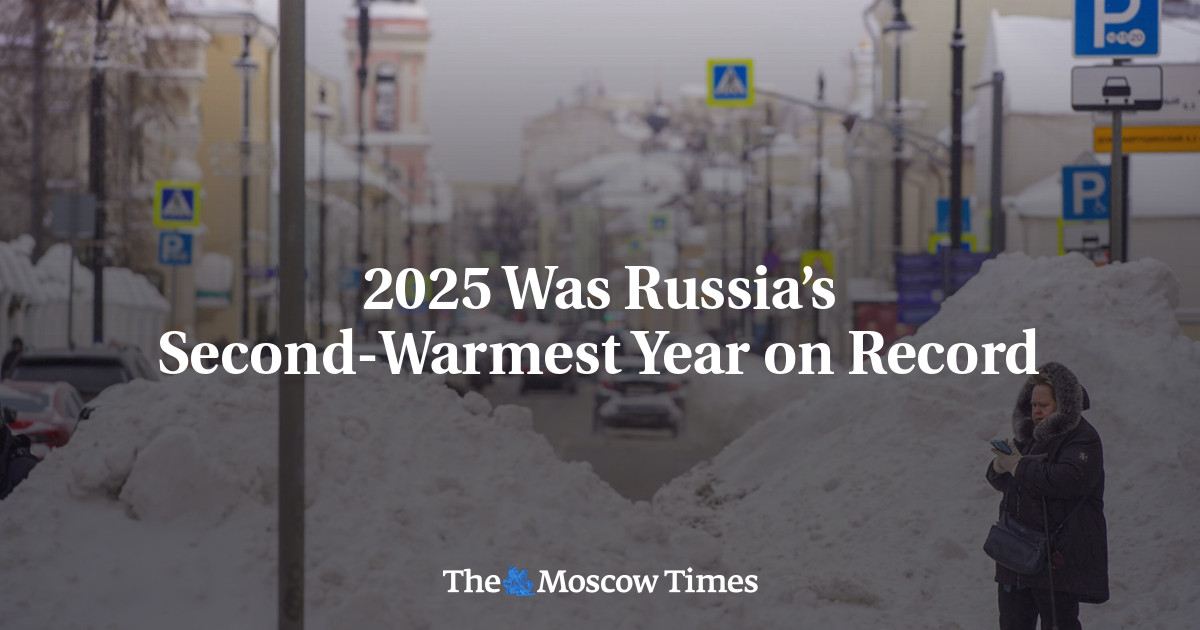
Russia Experiences Second-Warmest Year on Record, Arctic Warming at Alarming Rate
MOSCOW – Russia endured its second-warmest year on record in 2025, with temperatures 1.24 degrees Celsius above average, according to a new report from the state weather agency, Rosgidromet. The findings underscore the accelerating impact of climate change on the vast nation, a major fossil fuel exporter.
The report, released this week, indicated that 2025’s temperature anomaly was second only to 2020, which saw a 2.03-degree Celsius increase. The Arctic region, warming at a rate significantly faster than the global average, experienced its warmest winter and fall since 1951, and a spring season ranking as the third-warmest in the same period.
Several regions within Russia experienced record-breaking temperatures. The Central and Volga Federal Districts both set new heat records throughout 2025. With the exception of the Far Eastern Federal District, average temperatures across all other Russian federal districts were among the five highest recorded since 1936.
This warming trend is occurring as global average temperatures continue to rise. The global average surface temperature in 2025 reached 14.97 degrees Celsius, making it the third-warmest year ever recorded. Russia itself has warmed by 0.51 degrees Celsius over the past decade, compared to a global average increase of 0.2 degrees Celsius.
Beyond rising temperatures, Russia also saw a significant increase in precipitation. The country experienced 110% more precipitation in 2025 than average, according to the environmental news website Kedr, which first reported on the Rosgidromet findings.
Climate scientists have repeatedly warned about Russia’s vulnerability to extreme weather events, including heat waves and heavy rainfall, given its status as a major greenhouse gas emitter. The Moscow Times recently published an opinion piece highlighting how extreme winter storms in Russia serve as a “climate wake-up call” that the Kremlin appears to be ignoring.
The report from Rosgidromet adds to a growing body of evidence demonstrating the urgent need for climate action, not only in Russia but globally.
À ne pas manquer