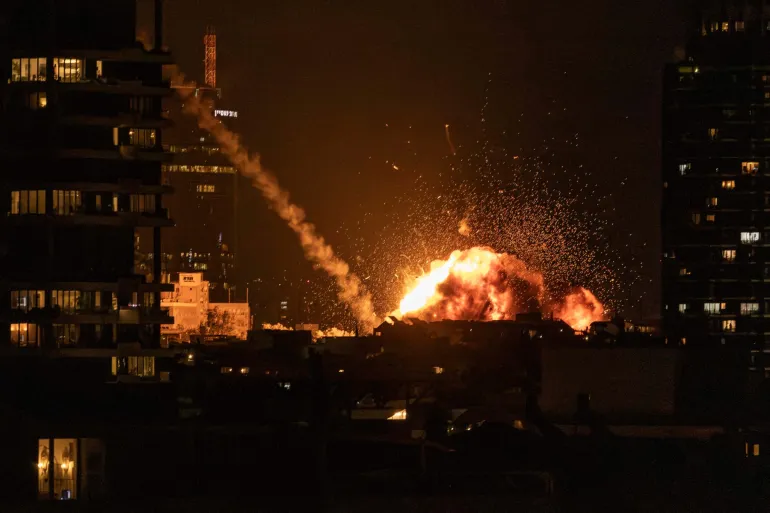
Escalation in Iran Conflict: Strikes Continue Despite Reported Talks, Gulf States Targeted
DUBAI, United Arab Emirates (AP) — Military operations between the United States, Israel, and Iran intensified Tuesday, with strikes hitting key facilities across the region and missile exchanges continuing even as the U.S. announced a temporary pause in strikes targeting Iran’s energy sector. The conflict, which began February 28, is raising concerns about wider regional instability and economic repercussions.
Iranian state media reported that U.S.-Israeli strikes targeted gas facilities in Isfahan and Khorramshahr. A second strike reportedly hit a gas administration building in Isfahan, though no casualties were immediately reported. Iranian air defenses attempted to intercept the incoming attacks.
In response, Iran continued launching missiles toward Israel, triggering air raid sirens in Tel Aviv, Dimona, Eilat, Haifa, Nahariya, and Hadera. Explosions were reported in Nesher and Nahariya, attributed to falling warheads.
The developments unfolded despite U.S. President Donald Trump announcing a five-day delay in strikes on Iran’s energy infrastructure on his Truth Social account, citing “constructive” talks with Tehran. However, U.S. officials clarified that the pause applies only to energy-related sites, with operations continuing against military, naval, ballistic missile, and defense industrial targets.
Iran has denied any recent negotiations with Washington, with both its foreign ministry and parliament speaker Mohammad Bagher Ghalibaf rejecting claims of talks. Pakistan also denied hosting negotiations, though expressed willingness to facilitate dialogue.
The conflict is no longer limited to direct exchanges between Iran, Israel, and the U.S. A Moroccan civilian contractor was killed and five personnel injured in an Iranian missile attack targeting Bahrain, according to the UAE Ministry of Defence, which described the incident as a “serious escalation.” Bahrain’s defense forces reported additional injuries.
The UAE reported intercepting five ballistic missiles and 17 drones, bringing the total intercepted since the escalation began to 357 ballistic missiles, 15 cruise missiles, and 1,806 drones. Bahrain stated it had intercepted and destroyed 153 missiles and 301 drones.
As of Tuesday, Israel’s health ministry reported 4,829 people injured by Iranian attacks since February 28, including 122 in the past 24 hours, with 111 still hospitalized, some in critical condition. The Israeli military claims to have struck over 3,000 targets in Iran, including missile launch sites, intelligence facilities, and weapons depots.
Inside Iran, authorities reported dozens of arrests on charges of collaborating with “hostile entities,” alongside efforts to identify and confiscate related assets.
Qatar reiterated calls for de-escalation, urging an end to the war and warning of significant economic repercussions. Doha stated it is not currently mediating in the conflict.
À ne pas manquer